
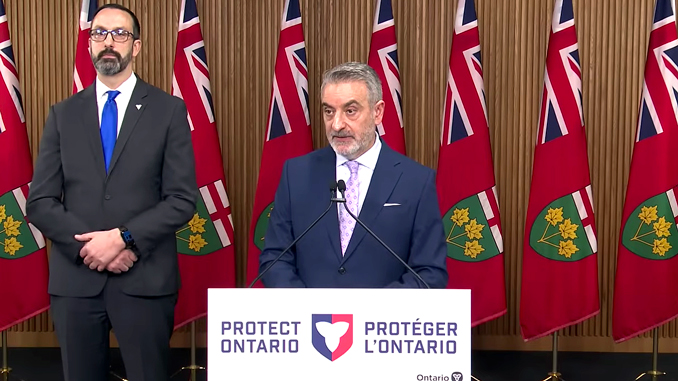
TORONTO — Ending a year of speculation as the province took over direct administration of several school boards, Education Minister Paul Calandra announced sweeping changes to the education system Monday (April 13).
The legislation announced, if passed, will restructure school board senior administration and strip financial accountability duties from trustees. It is the largest overhaul of school board operations since amalgamation in the late 1990s. He stopped short of constitutional reform to change French and Catholic education protections currently in place.
Three key changes are outlined in the legislation which was tabled that morning.
School board administration changes as the role of Director of Education will split between a Chief Executive Officer and a Chief Education Officer. The CEO will look after budget and administration, while the CEdO will be focused on curriculum delivery. CEOs will also take over decision making on local collective bargaining agreements with unions. The CEdO must have teaching credentials with the Ontario College of Teachers.
Trustees will lose the remaining budgetary powers they have had. They can comment on budgets when presented by the CEO, but they cannot directly change them. If a trustee board does not approve a board’s budget, it can be sent to the Minister’s office for approval.
Expenses and compensation for trustees will also be cut, and boards with more than 12 trustees will see that board reduced. The latter only affects the Toronto District School Board, which has 22 trustees.
Calandra told media Monday that Trustees will act more as the connection with and to parents, rather than in a fiscal governance role.
“Ontario’s education system must remain focused on its core responsibility: student success. In some school boards, that focus has been lost, and students are paying the price,” said Calandra. “We wanted to reduce the distractions that come for trustees from the system. The new role for trustees will be significantly reduced from what it was before.”
Catholic and French trustees will still be in charge of denominational and language issues.
“But at the same time, vastly reducing [trustees’] ability to cause division within the system, refocusing them on advocating on behalf of parents in the system,” Calandra said.
The minister also announced changes to student learning. This includes set exam dates across the province, and classroom participation/attendance performance will count towards their grades. For Grades 9 and 10 students, 15 per cent of their mark will be based on that, while Grade 11 and 12 students will see 10 per cent of their mark count based on attendance and participation.
The Minister of Education will receive new powers over capital projects at school boards, with the ability to oversee, redirect, or cancel a project when necessary, or appoint a third-party to do so, without the ministry taking over the administration of a school board.
The Ministry did not say if that includes changing school boundaries or increasing the scope of a capital project to circumvent the pupil accommodation review process. The Ministry of Education did not respond to The Leader’s questions on the status of the nearly 10-year school closure moratorium and if that will continue.
NDP education critic Chandra Pasma called the legislation another power grab by the Ford Government.
“This is another power grab by the Minister, shutting parents and communities out of our own schools,” Pasma said. “By further controlling appointments, budgets, and restricting what trustees can even discuss, this government is centralizing decision-making in Queen’s Park and sidelining local voices.”
Kathleen Woodcock, president of the Ontario Public School Boards’ Association spoke out against the legislation saying her organization was “deeply concerned.”
“Let’s be clear, removing these responsibilities from trustees means removing decisions from people who are directly accountable to the community,” Woodcock said. “Over the past several months, we have seen troubling decisions made in supervised boards without public consultation – decisions such as changing school bell times, lifting class size caps, eliminating programs, closing schools, and reducing supports for students in high-needs communities and those with special education needs. These decisions are being made by highly paid individuals – making as much as $350,000 a year – accountable only to the Minister of Education, not to local communities.”
Representatives from local school boards including the Upper Canada DSB, and the Catholic District School Board of Eastern Ontario have not yet commented on the legislation.
Discover more from Morrisburg Leader
Subscribe to get the latest posts sent to your email.